English Shadowing Practice
Paste a link to any English video — interview, TED talk, podcast, movie scene. Catlangu turns it into a sentence-by-sentence shadowing lesson with word-by-word pronunciation feedback. Free on iOS & Android.
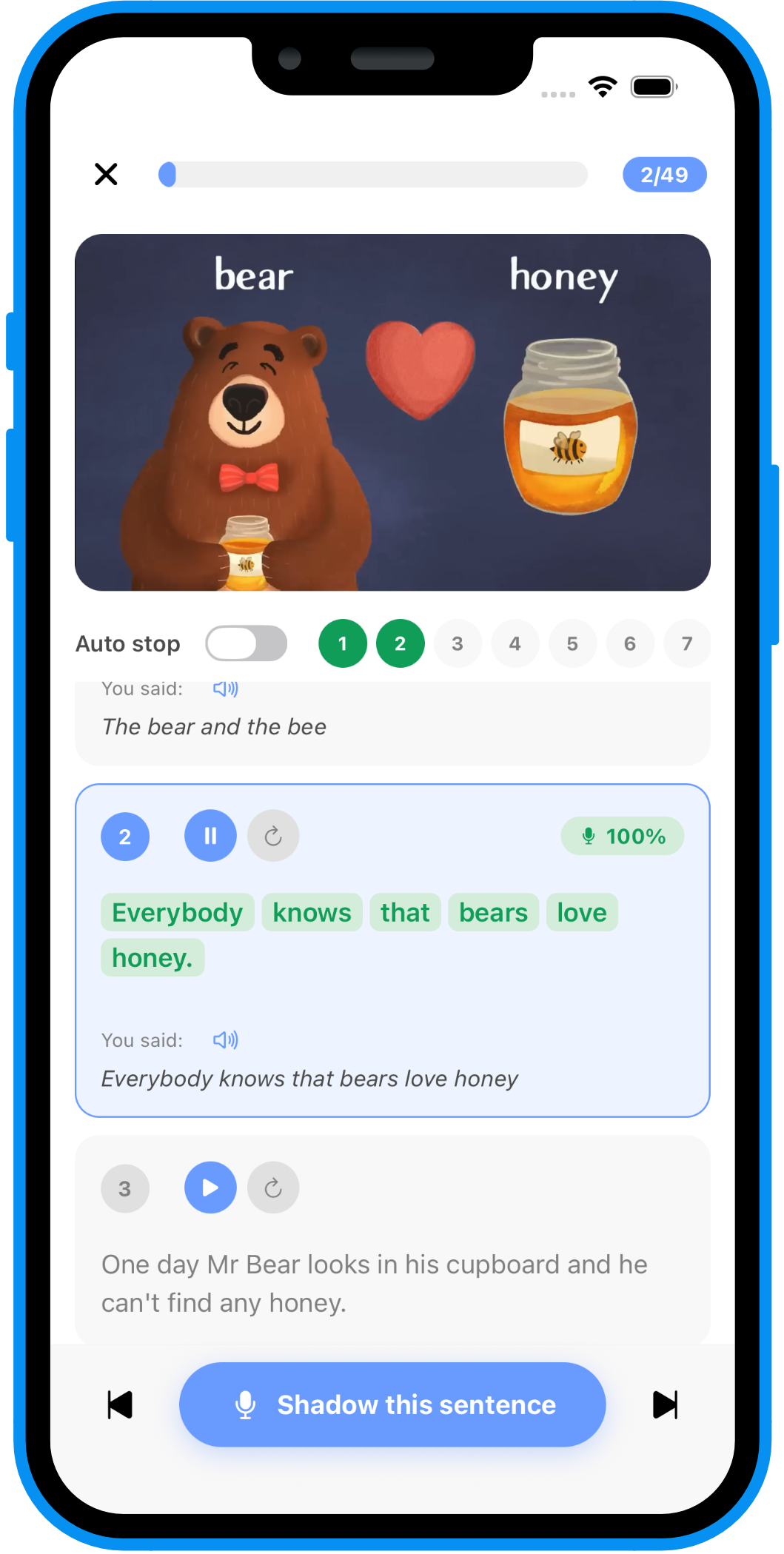
Shadowing is what professional interpreters do.
Shadowing — repeating a native speaker out loud the moment you hear them — is the single most powerful technique for natural pronunciation, rhythm, and intonation. It's how UN interpreters train. It's why immersion works. And until now, doing it well at home meant pausing videos manually a thousand times a day.
Trains your mouth, not just your ears
You build the muscle memory of native speech — the rhythm, the linking, the rising and falling intonation that no textbook can describe.
Closes the listening-speaking gap
Most learners can understand far more than they can say. Shadowing pulls your speaking up to match your listening — the fastest path to feeling fluent.
Picks up the things textbooks skip
Real native speech is full of contractions, filler words, slang, and rhythm patterns. Shadowing teaches them automatically — because you're repeating real people, not script readers.
Paste a link. Press play. Repeat.
The two-step loop, on every sentence:
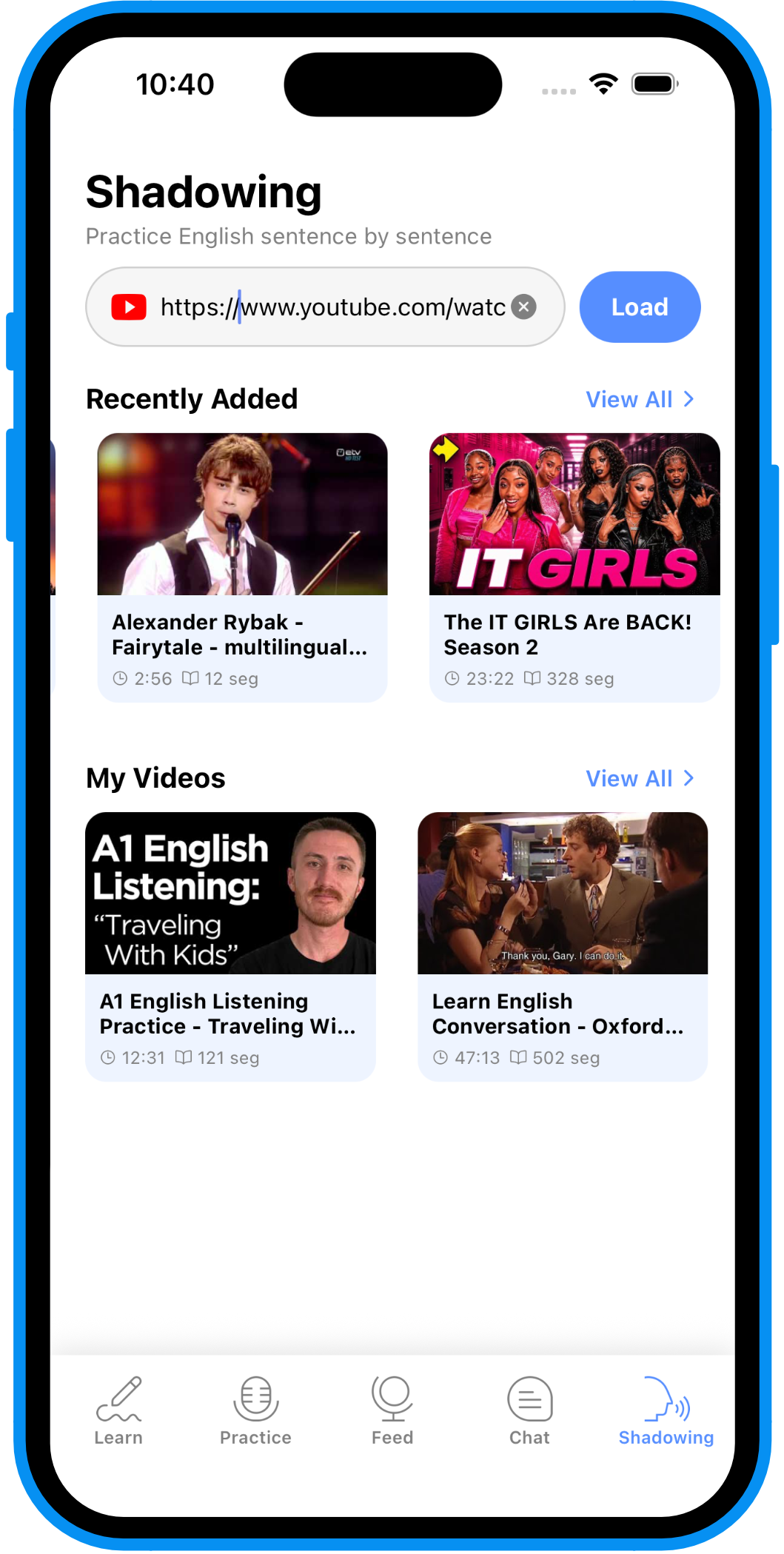
Paste any YouTube URL
Drop in a video link from YouTube and Catlangu fetches the English captions, splits them into clean sentences, and turns the whole video into a shadowing lesson. No link handy? Browse what other learners are shadowing right now and jump straight in.
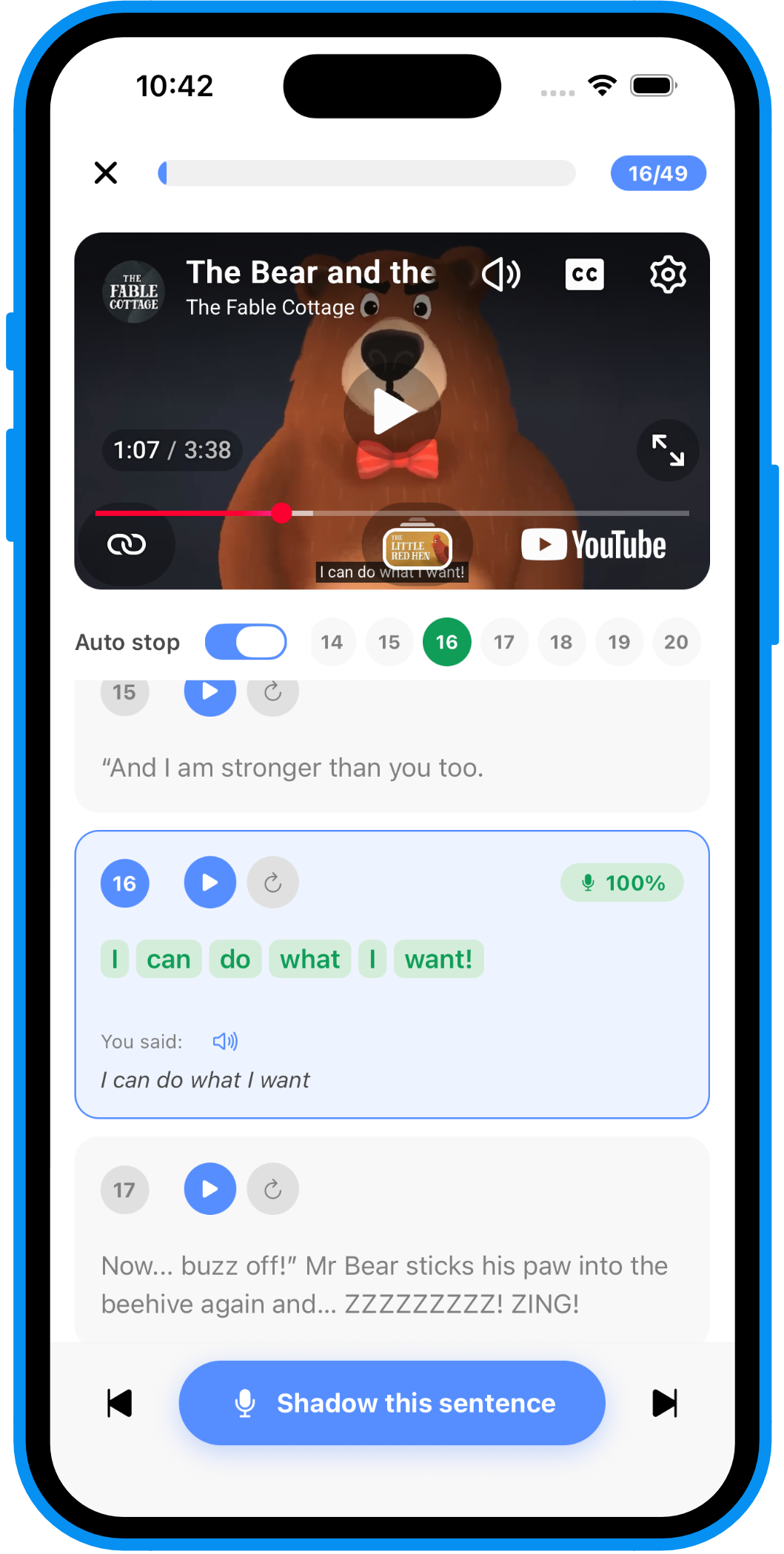
See exactly which words you nailed
Listen to the native audio, then tap the mic and repeat the sentence out loud. It reappears as color chips — green for the words you got right, red for the ones to work on — so you always know exactly where you stand.
How this is different from watching YouTube with subtitles.
Subtitles teach you to read English. Shadowing teaches you to speak it.
You bring the content
Not a fixed library you'll get bored of. Use the videos you actually want to watch — the YouTubers you follow, the TED talks you love, the scenes from your favorite series.
Word-by-word feedback
Not just "good job, you spoke." Every word becomes a green or red chip showing exactly where your pronunciation lands. The kind of granular feedback you'd normally pay a coach for.
Auto-stop, when you want it
Turn on auto-stop and skip the pause button entirely — the video halts right at each sentence break, so you stay in the rhythm of the speaker instead of the rhythm of your thumb.
Your progress is saved per sentence
Every recording you make and every score you earn is saved to your device. Open a video a week later and see exactly which sentences you already nailed — and which ones still need work.
What's worth shadowing today?
Almost any English video on YouTube works. A few that learners love:
TED Talks
Clear delivery, big ideas, captions that match the audio perfectly. The classic shadowing starter pack.
Late-night interviews
Natural conversational rhythm, contractions, fast humor — the English that real people actually speak.
Movie & TV scenes
Dramatic delivery and varied accents. The closest thing to living inside the story you're watching.
Podcasts on YouTube
Long-form, calm pace, real opinions — perfect when you want to settle into one speaker's voice for an hour.
Stand-up comedy
Punchlines depend on rhythm and pauses. Shadowing them teaches you the music of spoken English.
News reports
Crisp pronunciation, full sentences, formal register — ideal for business and academic English.
Questions about shadowing in English
What is shadowing in language learning?
Shadowing is the technique of repeating a native speaker out loud, almost in sync with them, copying their pronunciation, rhythm, and intonation as closely as possible. It's widely used by interpreters and serious language learners because it trains your mouth and ear at the same time — the fastest way to sound natural.
How long should I shadow per day?
Even 10–15 minutes a day produces noticeable results within a few weeks. Many learners do 20–30 minutes. Quality matters more than length — focus on really nailing each sentence rather than rushing through dozens.
Can I shadow any English video on YouTube?
Almost. Catlangu works with any YouTube video that has English captions available. If a video doesn't have captions, the shadowing lesson can't be built — but the overwhelming majority of popular English content has them.
Do I need a perfect accent for the scoring to pass?
No. The pronunciation scoring matches phonemes, not accents. You can sound like yourself and still score 100%. The point of shadowing isn't to lose your accent — it's to be clearly understood and to absorb the rhythm of natural English.
Will I see translations of the sentences?
The shadowing screen shows the English captions only. If you need to understand a word or phrase, pause and look it up — but most shadowing happens at a level you mostly understand already. The goal is producing the language, not decoding it.
Is it free?
Yes. You can shadow up to 10 videos per day for free. Catlangu Premium raises that to 30 videos per hour.
Pick a video. Press play. Shadow it.
Free to download. Free to start. No video library required — bring your own.