Learn the 2,500 Most Common English Words
English has half a million words. You don't need them. Catlangu teaches the 2,500 that matter — the same core words a native speaker actually reaches for, every single day.
The math behind word frequency.
Linguists call this the Zipf curve: a tiny core of words does almost all the work in any language.
words cover 50% of all everyday English sentences.
words cover roughly 85% of spoken English.
words cover ~90% of daily conversation — the conversational baseline.
words is where Catlangu takes you — past the baseline, into the vocabulary for work, opinions, and real depth.
Baseline research: Oxford English Corpus & Brown Corpus frequency analysis.
See it. Type it. Say it. That's the whole loop.
Every word is taught in three steps, inside a real sentence — never as an isolated flashcard. You can't skip the speaking part, because reading a word and saying a word are two different skills.
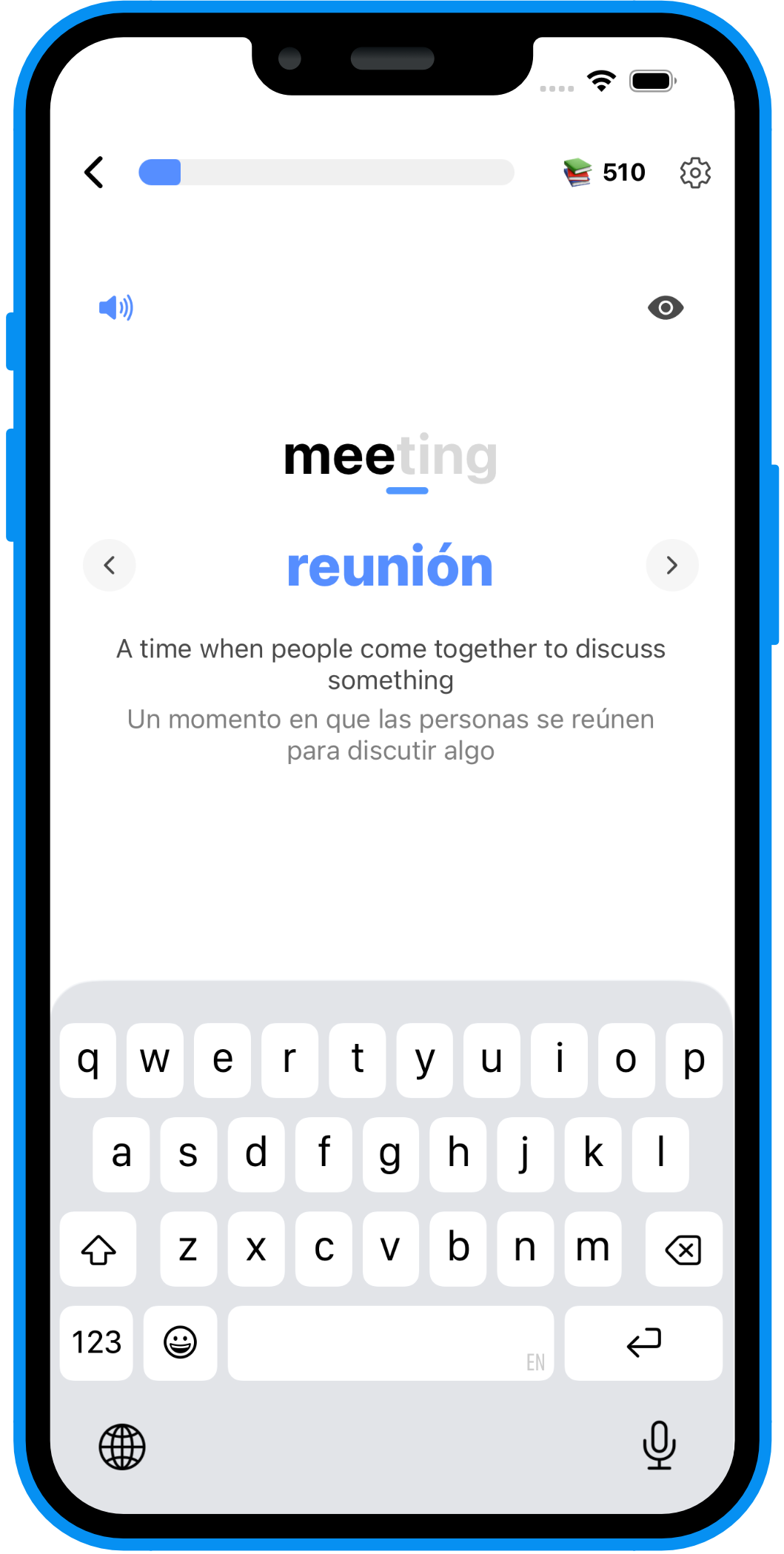
Meet the word
A new word appears with its meaning and a translation into your language. Native-speaker audio plays automatically, so you hear it before you ever try to say it.
- Meaning shown in plain English
- Instant translation into your language
- Native-speaker audio pronunciation
- Peek hint if you get stuck
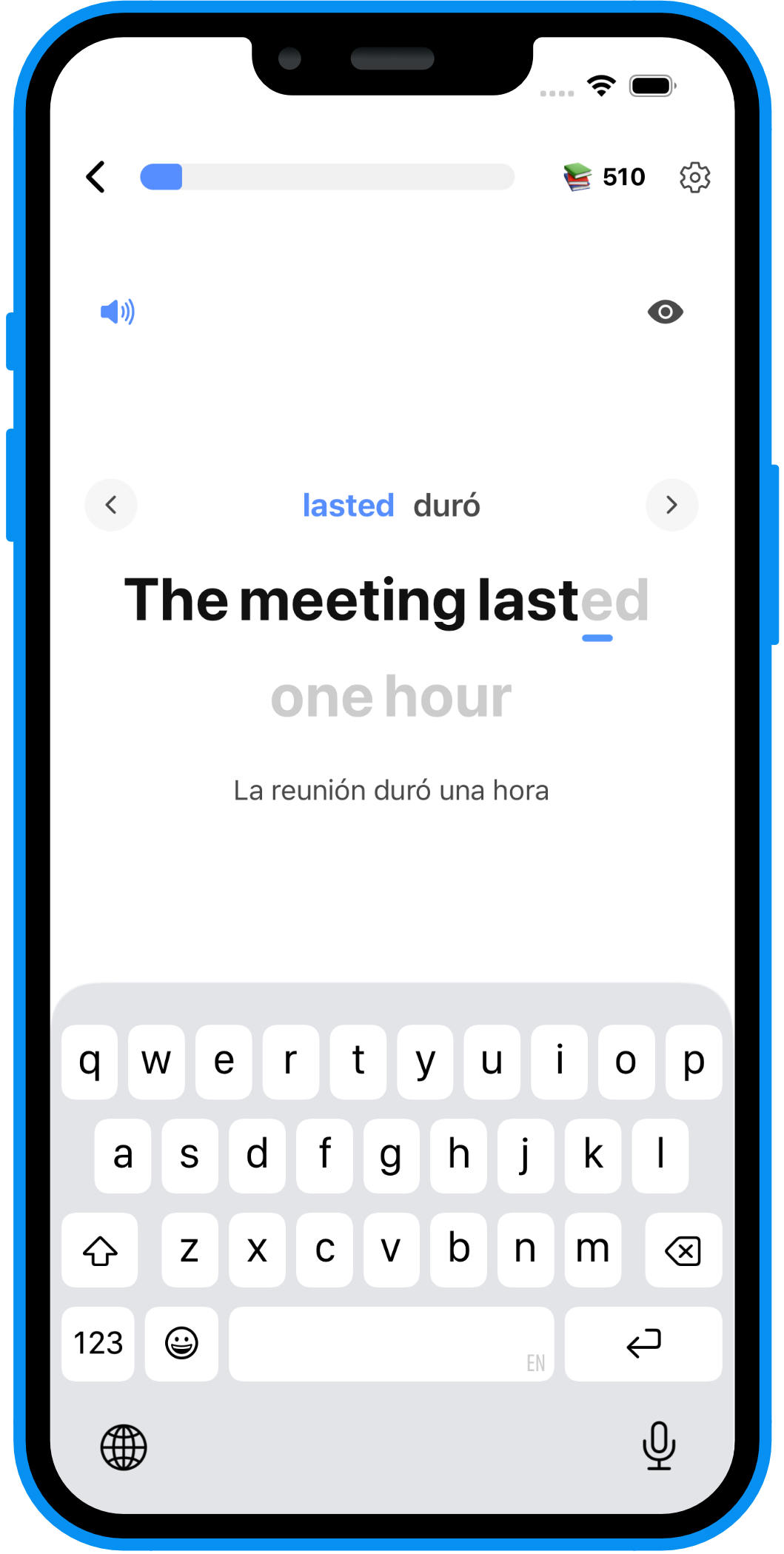
Type the sentence
The same word now appears inside a real, complete sentence — translated underneath. You type it letter by letter, green when you're right, red the instant you're wrong. The next letter waits until you fix it.
- Real sentences, never isolated words
- Translation always visible underneath
- Letter-by-letter feedback — no guessing
- Replay the audio anytime
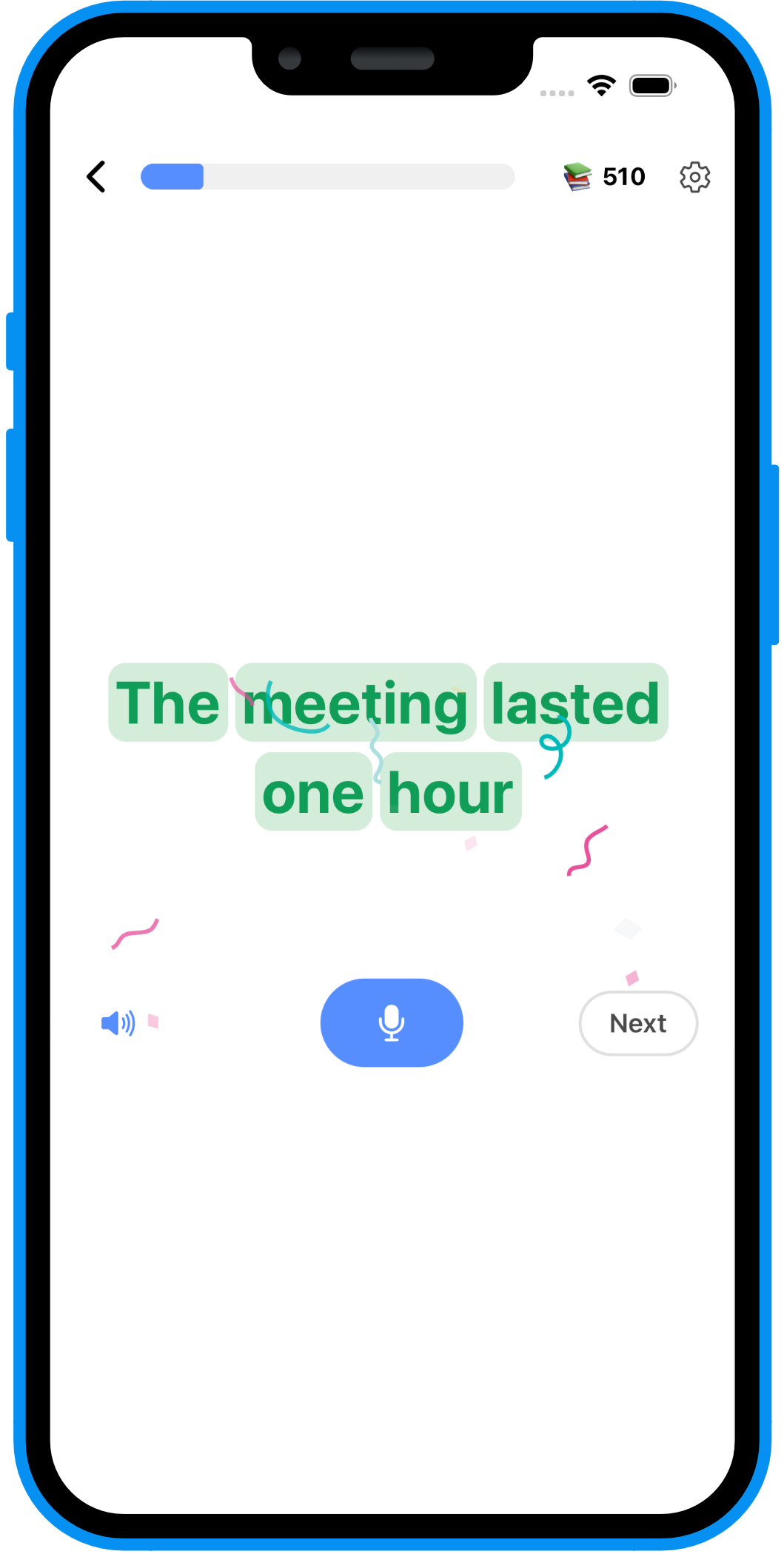
Say it out loud
Same sentence, no more typing. You tap the mic and say it. Speech recognition checks every word as you speak — correct words turn green, mispronounced ones turn red, in real time.
- Word-by-word pronunciation scoring
- Real-time feedback as you speak
- Phoneme matching, not accent-perfection
- Repeat until it's second nature
How this is different from every other vocab app.
Flashcard apps teach you to recognize words. Catlangu teaches you to produce them.
Sentences, not isolated words
You never see a word stripped from its grammar. Every new word arrives inside a complete, useful sentence — the same way native speakers actually use it.
You speak every lesson out loud
Most apps let you tap "I know this." Catlangu makes you say it. That's the difference between recognizing English and speaking it.
Progress measured in words, not points
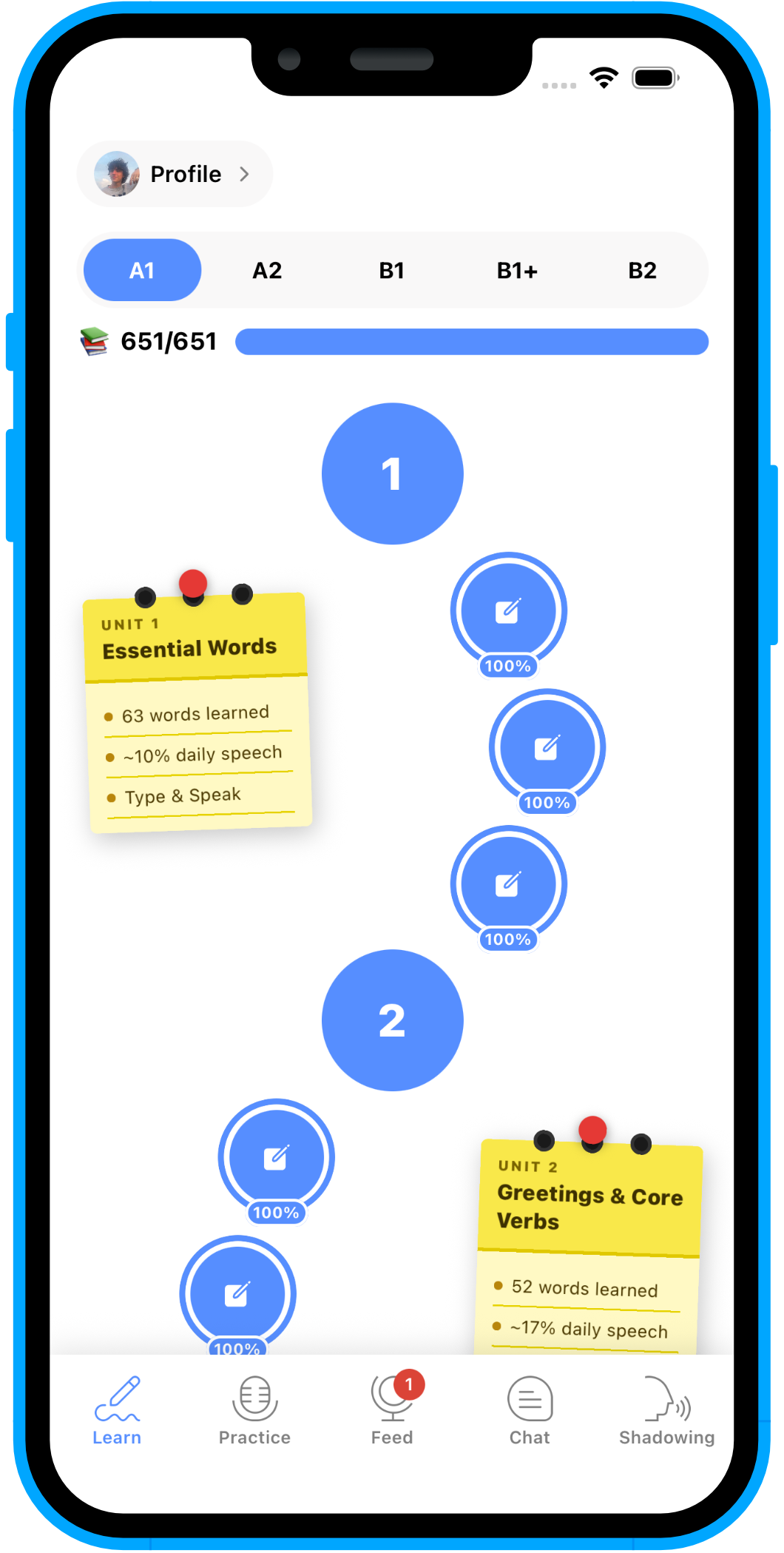
Finish a unit and you see "📚 50 words learned" — a real, countable thing you can use. Not 50 XP toward a meaningless level.
What you'll actually be able to do.
These aren't SAT vocabulary words. The 2,500 are the words behind every conversation you'll have — from ordering coffee to negotiating a salary.
Order food and drinks
Restaurants, cafés, room service — the words that come up before the meal even arrives.
Make plans with friends
"When are you free?" "Want to grab a coffee?" "I'll be there in 10." The fabric of social English.
Ask for directions and help
In a city, in a store, at an airport — the words that turn lost into found.
Hold small talk
Weather, weekends, work, family — the conversations that lead to every other conversation.
Handle work and interviews
Salary talk, meetings, emails — the vocabulary the first 1,500 words don't cover, and the next 1,000 do.
Understand real conversations
Movies, podcasts, real conversations — suddenly comprehensible because the 2,500 most common words are doing the heavy lifting.
Questions about the 2,500-word approach
Why 2,500 words, not just the 1,500 "essential" ones?
Linguistic research shows the most common 1,000–1,500 words cover 85–90% of everyday spoken English — that's a real, well-documented baseline. But "getting by" isn't the same as being comfortable in a work meeting, an interview, or a real friendship. Catlangu takes you past the baseline to 2,500 words, across 5 levels from complete beginner to advanced, so you're not just surviving conversations — you're actually fluent in them.
How long does it take to learn all 2,500 words?
It depends on how much you practice. The curriculum is split into 5 levels (51 units total). Learners doing a little each day typically finish the first level — free, and enough for real daily conversation — in a few weeks, with the full 2,500 taking several months at a steady pace. There's no streak pressure — go faster if you have time, slower if you don't.
Why typing AND speaking? Isn't that the same word twice?
No — and that's the point. Recognizing a word is one skill. Spelling it is another. Saying it out loud is a third. Most apps train only the first one, which is why people study for years and still can't speak. Catlangu drills all three, for every one of the 2,500 words.
Do I need to know any English to start?
Some basics help — the alphabet and a few survival words. But the sentences start simple ("I am here", "She has a cat") and the translation in your native language is always visible. Beginners can absolutely start here.
Does the speech recognition need a perfect accent?
No. The pronunciation scoring matches sounds (phonemes), not accents. You can sound like yourself and still pass. The point is intelligibility, not imitation.
Is it free?
Yes. The first level is free for everyone — that alone covers the 1,500-word conversational baseline. Catlangu Premium unlocks all 5 levels and the full 2,500 words. No credit card to start.
Start with the 2,500 words that matter.
Free to download. Free to start. First level unlocked from day one.